|
|
| (4 intermediate revisions by the same user not shown) |
| Line 2: |
Line 2: |
|
| |
|
| ==Summary== | | ==Summary== |
| ''<Describe the profile in about a paragraph using user-oriented language. Focus on what it accomplishes for a user (i.e. the Use Cases). Don't get into how it works, leave that to the Details section.>''
| | Defines the data required to be transferred, accepted and displayed for modulated ion therapy treatment plans produced by a Treatment Planning System (TPS) and consumed by a Treatment Management System (TMS). |
|
| |
|
| | ==Benefits== |
| | The profile removes incompatibilities or inconsistencies in plan interpretation from one system to another. Given the critical nature of the data being sent to the treatment management system (TMS), these inconsistencies needed to be removed by explicitly defining one method of describing plan content for ion therapy treatment modes. |
|
| |
|
| ''<Insert a simple graphic that, at a glance, visually summarizes what the profile is about. Do not use an actor/transaction diagram here. Show your graphic to someone for 5 seconds (literally) and ask them what it's about. If what they say hits the main points in your summary paragraph, you have succeeded. E.g. a graphic of a hospital, a clinic, and a lab with patient records moving between them. .>''
| | The profile also demands that the user can display the original plan content on the receiving system and thus allow the user to compare the original data to the receiving system’s internal, working version of the plan. This can serve as an auditing tool if information doesn’t match up after a data transfer. This profile facilitates this by specifying the mandatory, minimally available data for comparison of plans. This allows the user to see the original plan content so that it is readable not just in DICOM format |
| | |
| ''<See [[Help:Contents#Tips_.26_Tricks| Help - Tips and Tricks]] for details on inserting an image/graphic.>''
| |
| | |
| ==Benefits==
| |
| ''<If the profile can improve Cost, Safety, Quality or Efficiency then list the specific examples of that benefit (e.g. error reduction, increased throughput) and how they come about (e.g. SWF reduces patient errors due to mistyped demographics at the modality by transfering demographics electronically from the Order Filler). Consider using a bullet list for readability. Such benefits help users and vendors make the business case for the profile. If the profile does not improve any aspect of Cost, Safety, Quality or Efficiency feel free to talk about something else here.>''
| |
|
| |
|
| ==Details== | | ==Details== |
|
| |
| ''<A few paragraphs, if appropriate, providing more details (mostly in user-speak, not tech-speak) on what the profile does and how it works.>''
| |
|
| |
| ''<If the user might be familiar with the mechanisms used by the profile, you can mention them here. E.g. Evidence Documents is based on DICOM Structured Report (SR) Templates.>''
| |
|
| |
| ''<If the user might have an appreciation for the problems addressed in the profile, you can mention them here, but keep it short. E.g. Mapping HL7 Order fields to DICOM Modality Worklist attributes can be inconsistent in the marketplace, so Scheduled Workflow provides vendors with more detailed instructions.>''
| |
| | | |
| ==Systems Affected== | | ==Systems Affected== |
| ''<List (in user terms) the types of systems they might expect to have implemented actors from this profile, e.g. RIS, PACS, HIS, CAD Workstation, etc. and for each, how it would participate.>''
| |
|
| |
|
| * ''PACS systems may store, manage, and/or display Evidence Documents.'' | | |
| * ''Display systems may query, retrieve and display Evidence Documents.'' | | * ''Treatment Planning Systems (TPS)'' |
| * ''Reporting workstations may retrieve, process and include details from Evidence Documents in reports
| | * ''Treatment Management Systems (TMS)'' |
|
| |
|
| '''Actors & Transactions:''' | | '''Actors & Transactions:''' |
|
| |
|
| ''<Insert an actor-transaction diagram, and or list of Content Definitions>''
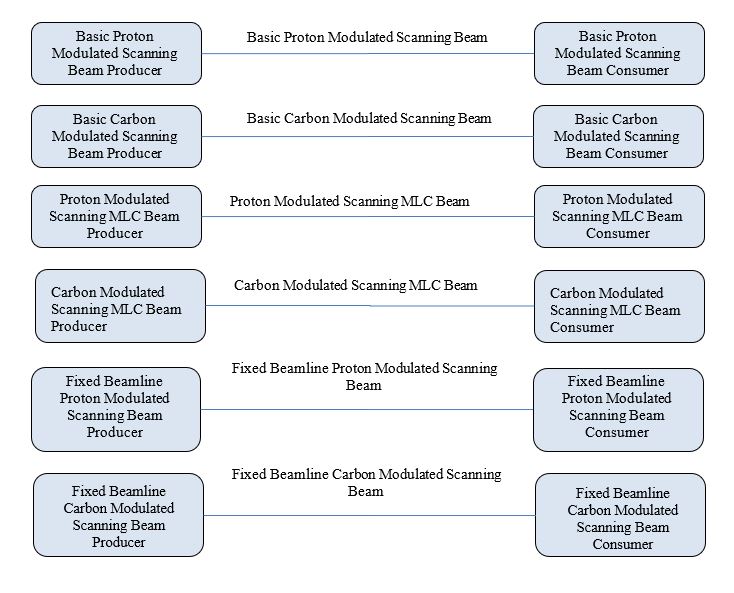
| | [[File:TDPC-Ion_Actor_Transaction_Diagram.JPG]] |
|
| |
|
| ==Specification== | | ==Specification== |
|
| |
|
| '''Profile Status:''' [[Comments| Final Text]] | | '''Profile Status:''' [[Comments| Draft Text]] |
| ''<Replace "Final Text" with "Trial Implementation" or "Public Comment" as appropriate.>''
| |
|
| |
|
| '''Documents:''' | | '''Documents:''' |
|
| |
|
| ''<Provide direct links to the specific volumes or supplements, and list the volume sections relevant to this profile. This is a simple inventory of official normative and informative text. If you would like to provide a reading guide or walkthrough of what is in each of the different sections for implementers or users, do that in the Profile FAQ or the Profile Implementation Page linked below. If the profile uses transactions from multiple Tech. Frameworks, repeat the structure below.>''
| |
|
| |
|
| [http://www.ihe.net/Technical_Framework/index.cfm#radiology IHE Radiology Technical Framework:]
| | '''Underlying Standards:''' |
| :* [http://www.ihe.net/Technical_Framework/upload/ihe_tf_rev8.pdf Vol. 1] - Section 5 (SWF Profile)
| |
| :* [http://www.ihe.net/Technical_Framework/upload/ihe_tf_rev8-2.pdf Vol. 2] - Sections 4.8 to 4.10, 4.14 to 4.19, and 4.23
| |
| :* [http://www.ihe.net/Technical_Framework/upload/ihe_tf_rev8-3.pdf Vol. 3] - Appendix E
| |
|
| |
|
| '''Underlying Standards:'''
| | * [http://dicom.nema.org DICOM] |
|
| |
|
| ''<list all the standards on which the profile is based; if possible with links to sources>''
| |
| :* [http://dicom.nema.org DICOM]
| |
| :* [http://www.hl7.org HL7]
| |
| :* ...
| |
|
| |
|
| ==See Also== | | ==See Also== |
|
| |
| ''<The following sections can be left out if there is nothing to point to. This is just to show where such information can go.>''
| |
|
| |
|
| |
|
| '''Related Profiles''' | | '''Related Profiles''' |
|
| |
| ''<List profiles this one depends on, profiles that depend on this one, profiles that are synergistic with this one. Start with the name of the other profile as a link and then explain the relationship.>''
| |
|
| |
| * ''[[Reporting Workflow]] [RWF] may use Evidence Documents as inputs to the reporting process.''
| |
| * ''[[Simple Image & Numeric Reports]] [SINR] may include data copied from Evidence Documents.''
| |
| * ''[[Cross-enterprise Document Sharing for Imaging]] [XDS-I] can be used to share Evidence Documents between sites over a network.''
| |
| * ''[[Portable Data for Imaging]] [PDI] can store Evidence Documents on media such as CDs.''
| |
| * ''[[Import Reconciliation Workflow]] [IRWF] can fix patient ids, etc. of Evidence Documents when importing.''
| |
|
| |
|
|
| |
|
| '''Consumer Information''' | | '''Consumer Information''' |
|
| |
|
| The [[Profile FAQ Template]] answers typical questions about what the Profile does. ''<Replace the link with a link to the actual FAQ page for the Profile>'' | | The [[TPPC-Ion FAQ]] answers typical questions about what the Profile does. |
|
| |
|
| The [[Profile Purchasing Template]] describes considerations when purchasing equipment to deploy this Profile. ''<Replace the link with a link to the actual Purchasing page for the Profile>'' | | The [[TPPC-Ion Purchasing]] describes considerations when purchasing equipment to deploy this Profile. |
|
| |
|
| '''Implementer Information''' | | '''Implementer Information''' |
|
| |
|
| The [[Profile Implementation Template]] provides additional information about implementing this Profile in software. ''<Replace the link with a link to the actual Implementation page for the Profile>'' | | The [[TPPC-Ion Implementation]] provides additional information about implementing this Profile in software. |
|
| |
|
| '''Reference Articles''' | | '''Reference Articles''' |
|
| |
|
| ''<List References (good and bad) (with link if possible) to Journal Articles that mention IHE's work (and hopefully include some analysis). Go ahead, Google: IHE <Profile Name> abstract or Google: IHE <Profile Name> and under the "more" select "Scholar". You might be surprised. >''
| |
|
| |
|
|
| |
|
| Line 89: |
Line 58: |
| [[Category:RO Profile]] | | [[Category:RO Profile]] |
| [[Category:DICOM]] | | [[Category:DICOM]] |
| [[Category:RO todo]]
| |
Summary
Defines the data required to be transferred, accepted and displayed for modulated ion therapy treatment plans produced by a Treatment Planning System (TPS) and consumed by a Treatment Management System (TMS).
Benefits
The profile removes incompatibilities or inconsistencies in plan interpretation from one system to another. Given the critical nature of the data being sent to the treatment management system (TMS), these inconsistencies needed to be removed by explicitly defining one method of describing plan content for ion therapy treatment modes.
The profile also demands that the user can display the original plan content on the receiving system and thus allow the user to compare the original data to the receiving system’s internal, working version of the plan. This can serve as an auditing tool if information doesn’t match up after a data transfer. This profile facilitates this by specifying the mandatory, minimally available data for comparison of plans. This allows the user to see the original plan content so that it is readable not just in DICOM format
Details
Systems Affected
- Treatment Planning Systems (TPS)
- Treatment Management Systems (TMS)
Actors & Transactions:
Specification
Profile Status: Draft Text
Documents:
Underlying Standards:
See Also
Related Profiles
Consumer Information
The TPPC-Ion FAQ answers typical questions about what the Profile does.
The TPPC-Ion Purchasing describes considerations when purchasing equipment to deploy this Profile.
Implementer Information
The TPPC-Ion Implementation provides additional information about implementing this Profile in software.
Reference Articles
This page is based on the Profile Overview Template
